
 Help Center


The Organic Certification Journey: Understanding the Process
At Oregon Tilth, we believe the organic industry is a living, evolving ecosystem grounded in nurturing our environment, strengthening our connections, and enriching ourselves through the power of education. Founded on the belief that food and agriculture should be equitable, sustainable, and safe, we recognize that this won’t be achieved by certification alone, but it’s a transformative place to start.
Consumers are reshaping the marketplace, empowering communities to transform our food system into one that is more resilient, equitable, and in harmony with the land and its inhabitants. Our goal is to demonstrate how these values can be turned into opportunities to build a more sustainable food system for generations to come and how producers can grow and benefit from it.
What sets us apart from other certifiers is our legacy of forming connections and partnerships throughout the organic community. As a certifier, we offer a purpose-driven path for farmers, growers, and processors to build trust with their consumers. Our certification, education, and client experience teams are here to guide you through the certification process. With 50 years of experience, our approach is grounded in connection to the land, the people, and the environment. We start from the soil upwards and nurture our relationships with the organic community through creating partnerships and offering support, education, and advocacy.
As we reflect on our journey and look ahead, one truth stands out: connection is the force that sustains us.
The Organic Certification Journey
How the team at Oregon Tilth will help to guide you:
- Provide a clear and detailed explanation of the certification process, including the requirements for organic certification, documentation needed, and average time frames
- Personalized support from our team of certification specialists
- Access to a wealth of information on organic certification, including training, webinars, and other educational resources.
- The opportunity to join a community of like-minded farmers, processors, and food industry advocates.
What the Certification Process Entails
A clear, step-by-step overview of maintaining your organic certification
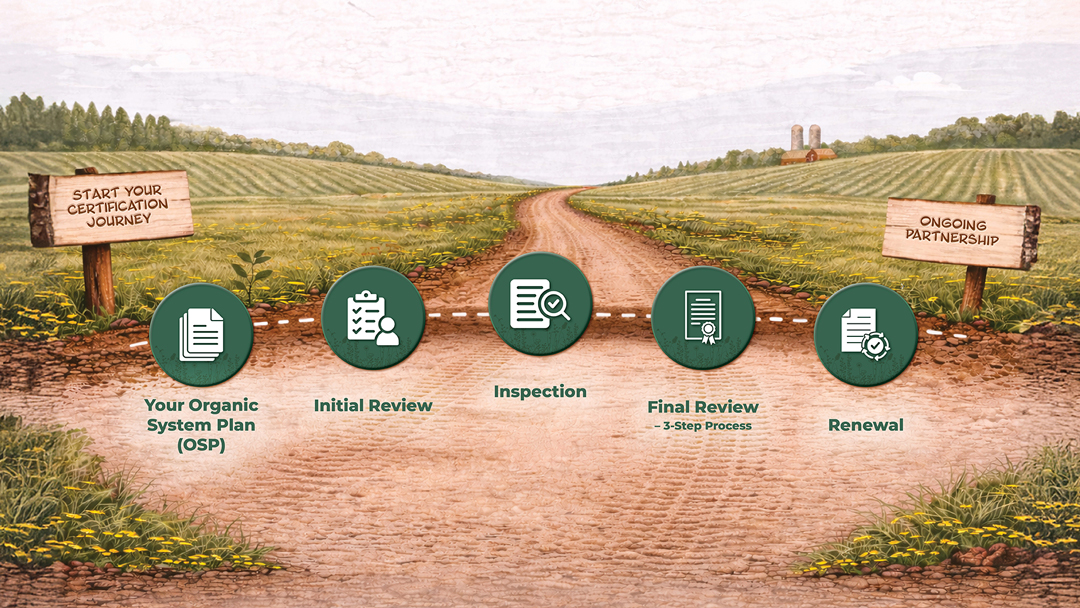
1. Your Organic System Plan (OSP)
The Organic System Plan (OSP) is the foundation of the organic certification process. It is a living document which will reflect the current state of your organic systems at any time. When you first apply for organic certification with Oregon Tilth, you will work with the Applicant Experience Team to submit your OSP for review – this is essentially your application for certification. The importance of your OSP cannot be over-emphasized, it is a comprehensive document that outlines the strategies, practices, and measures implemented by operators to ensure compliance with organic standards.
2. Initial Review
Once a complete application is received, Oregon Tilth assigns it to a review team to conduct a thorough desk review of all submitted materials to USDA National Organic Program (NOP) standards. The review team carefully evaluates the applicant’s OSP to ensure the operator will maintain compliance, including details on practices, inputs, and recordkeeping systems. All input products listed in the application are cross-referenced against the National List of Allowed and Prohibited Substances to confirm their suitability for use in organic production.
- Reviewers of Crop OSPs assess field histories, buffer zone descriptions, and any documentation related to the land’s transition to organic management.
- For Livestock operations, reviewers additionally examine animal health care practices, living conditions, access to pasture documentation, and the source and certification status of feed to ensure compliance with NOP livestock standards.
- For Handling operations, reviewers assess facility descriptions, cleaning and sanitation protocols, pest management practices, and product flow to evaluate the prevention of commingling and contamination of organic products.
If areas of concern or gaps in compliance are identified during this review, the applicant is issued a Request for Information (RFI), asking them to provide clarification or additional documentation before the process moves forward.
Once the review team is satisfied that the operation demonstrates a strong foundation for compliance with NOP standards, the application advances to the next stage, in which an on-site inspection is scheduled with an independent, accredited inspector.
3. Inspection: What Happens During an Inspection and What to Prepare For
Overview: All certified operations are subject to a mandatory annual inspection within the calendar year.
How it will be scheduled: You will receive an email from an Oregon Tilth team member that identifies your assigned inspector, and will help to coordinate the date and time of your inspection.
What to expect: Throughout the year, check to make sure your Organic System Plan modules measures are up-to-date and accurate. It’s best to review and organize pre-inspection checklists and common records that will be inspected.
Once finished, our inspector will review the inspection with you and provide a summary of any additional information required, changes to your OSP, or noted concerns on the exit interview form. The inspection report will be posted to your MyOTCO file upon completion.
What to have ready: Oregon Tilth has pre-inspection checklists available for each scope, to help you know what to have prepared.
4. Final Review – 3-Step Process
- Final Review: After your inspection, your inspector will write up a report of their findings, and share it with your Client Services Team. Your Client Services Team will then review this inspection report and determine if you are in compliance with organic regulations. The review process can take weeks to months, depending on the complexity of your operation, the findings of the inspector, how long requests for information take to complete, and other factors.
- Certification Decision: Your Client Services Team will let you know when your review is complete, and then issue you an updated certificate to signify this achievement.
- Certification Issuance: Once final review is complete, the operation is logged in the Organic Integrity Database as being fully certified and an organic certificate is issued by email or printed and mailed according to client preferences.
4. Renewal
As a client of Oregon Tilth, you are required to submit renewal paperwork annually to maintain compliance with the standards set forth by the NOP. This is your opportunity to review your paperwork, and report any changes that may have been missed throughout the year. This renewal application should cover any changes to your Organic System Plan (OSP), as well as a report of accurate sales figures from the previous year. Renewal fees may be paid during the renewal process, or our accounting department will issue you an invoice once the renewal is processed. Our renewal form is available on our website. We will also send you renewal reminders as the date approaches with instructions for completion.
It is important to remember that renewal of your certification is a separate process from the inspection and certification decision.
Noncompliances
Throughout your certification lifecycle, you may receive a ‘reminder’ or a notice of ‘noncompliance’. A noncompliance is issued when an inspection, review, or investigation reveals that your operation is not compliant with the relevant standards, but the concern brought up is correctable.
It is important to note that noncompliances are not issued as threats, and that they do not carry accusatory implications. Please see them as an opportunity to work with us in order to keep your operation in compliance with NOP standards.
Common Issues That Can Affect Your Certification
A few recurring issues can lead to noncompliances or delays in certification:
- Unpaid fees: One of the most common issues. If you’re having trouble paying certification or inspection fees, please reach out, we’re here to help.
- Missed inspections: When your inspector reaches out to schedule your inspection, please coordinate with them. Not doing so may lead to non-compliance.
- Late renewals: Submit your renewal materials by your due date to keep your certification active.
- Unreported changes: Notify us in advance of any new inputs, land, products, or facilities so we can update your Organic System Plan.
- Outdated contacts: Let us know if your primary contact changes so important updates don’t get lost.
Organic certification is an ongoing journey, one that shifts and grows alongside your operation. At Oregon Tilth, we see this work as a partnership built on trust, transparency, and a shared commitment to protecting organic integrity.
By understanding the certification process, maintaining clear communication, and keeping your Organic System Plan current, you help uphold the integrity of the organic label while strengthening your own systems for long-term success. Our team is here to support you at every stage, offering guidance, education, and partnership as you navigate both the requirements and the opportunities of organic certification.
Together, we can continue building a resilient, equitable, and values-driven food system, grounded in integrity and sustained by connection.
Contact Information:
For all questions related to your certification status, review, inspection, etc: please contact your Client Services Team:
- Red: red@tilth.org | (541) 241-8037
- Orange: orange@tilth.org | (541) 226-3176
- Yellow: yellow@tilth.org | (541) 279-2232
- Green: green@tilth.org | (541) 304-2302
- Blue: blue@tilth.org | (541) 279-2676
- Indigo: indigo@tilth.org | (541) 291-4919
If you don’t know who your Client Services Team is, please contact our main office and you will be directed to the right team: organic@tilth.org | (503) 378-0690
For all questions related to billing, please contact our finance department: accounts@tilth.org | (503) 378-0690
To request a transaction certificate, and for export-related questions, please reach out to our export department: export@tilth.org
Understanding the Organic Certification Process Guidebook
A Guide to Navigating Your Certification Journey